


Derek Eder
Civic Tech Builder
Stabilizing the Sustainability Fund
Published on Mar 16, 2026
On Feb 13, 2026 I shared a memo with the Oak Park Village board and staff on ways we could stabilize the funding for sustainability in Oak Park. This memo was drafted in advance of the March 18, 2026 Board Study Session on the Sustainability Fund. Village staff prepared their own memo and recommendations, which are available here.
March 21, 2026 Update
The Village Board discussed revenue sources for the Sustainability Fund on March 18. You can watch the full discussion here.
The discussion was a productive one, and the work of this memo and staff’s own helped set the table for it. I believe the primary goals of this memo, to treat sustainability as a core service of the Village, find ways to fund the current spending level, and expand it in future years, were met.
More details will be worked out in future Board and Finance Committee meetings, but initial consensus and direction from the Board was set on many of the items in this memo. Here’s my summary of that discussion:
A. Invest annually from the General Fund in Energy Efficiency Grant and Loan Programs
There was broad support for increasing funding for the Energy Loan Programs launched last month - the real question is by how much. The loans currently charge no interest, and staff will explore scenarios at different interest levels at a future board discussion.
B. Move Office of Sustainability staff salaries to the General Fund
There was unanimous consensus to move staff salaries to the General Fund. The Office of Sustainability has been in existence since 2009 and my colleagues agreed that it is time to move them to the same funding source as other core Village staff.
C. Increase the plastic bag tax
There was general consensus to increase the plastic bag tax. This is in alignment with recommendations from the Environment and Energy Commission, who have prepared their own memo and recommendations for plastic bag taxes in Oak Park through 2030.
D. Electric Charging Fees
Staff recommended that these fees stay in the Parking Fund to cover related expenses and that the annual revenue was $25,000 - not a significant amount to have an impact.
E. Increase vehicle registration fees for gas cars, reduce them for EVs
Staff noted that Vehicle License Fees have very specific uses that are restricted by State Statute, so they can not be raised to use as a revenue source for Sustainability. The discussion then turned towards reducing registration fees for electric vehicles to incentivize purchasing them, similar to what we did earlier this year with building permit fees. Staff will look into this for a future board discussion.
F. Increase gasoline tax
Staff identified that the Motor Fuel Tax is capped by State Statute and has legal restrictions on use.
G. Identify new revenues from the Water Fund
Staff recommended increasing sewer and water fees that residents pay. However, the board reached a consensus that increasing these fees would be too regressive and potentially reduce funding from the Lead Service Line Replacement program.
Other revenue sources not mentioned in this memo were also discussed:
Natural Gas Use Tax
Staff identified that we could raise this tax to match that of the City of Chicago, which could raise $80,000 annually. I am interested in pursuing this and have asked staff to further look into it.
Utility taxes
Utility taxes are already at the maximum level capped by the State and can not be increased.
Parking fees
Similar to Vehicle License Fees, the use of these funds are limited by State Statute.
Thank you again to my colleagues on the Board and Village Staff in working collaboratively to ensure we have the resources we need to continue to address our contributions to climate change and fight for a future we can all be proud of! I am looking forward to irioning out the remaining details and enshrining this in our 2027 budget.
Stabilizing the Sustainability Fund
Download the PDF version of Stabilizing the Sustainability Fund
Background and purpose
In 2022, the Village of Oak Park declared a climate emergency and passed the Climate Ready Oak Park (CROP) plan. Over 3 years later, that emergency persists, and while efforts have been made to reach the ambitious goal of a 60% reduction in greenhouse gases by 2030 and 100% by 2050, we are still not on track to meet either of these goals.
To put the scale of this goal into context, it is helpful to break it down and look at the 3 primary sources of emissions in our Village. According to our 2022 Greenhouse Gas Inventory, 38.8% comes from residential buildings, 32.9% from commercial buildings and 25.5% from transportation. According to the 2023 American Community Survey, 16.5% of our 23,267 households are already using electric heat. To achieve a 60% reduction for just residential properties in Oak Park, we would have to electrify 11,663 households by 2030 at a rate of 2,333 households per year.
Several new programs have been started by the Village in the past two years to help electrify and improve the efficiency of our residential and commercial buildings, including the Climate Ready Energy Grants, Climate Ready Business Grants, and Building Benchmarking. Our efforts are starting to show some results, but we must do much more, much faster.
These programs, especially the grants, have dramatically increased our spending in the Sustainability Fund since 2024. Since then, the current revenue sources have not been enough to keep funds replenished year to year. If Oak Park is to stay committed to sustainability and our own CROP goals, we must treat it as a core service of the Village and find ways to fund the current spending level and expand it in future years.
Based on past adopted budgets and presentations from Village staff, it is projected the Village of Oak Park Sustainability Fund will run out of funds before the end of 2027 if no interventions are made.
Below is a table and chart of past and projected expenditures, revenue and available funds in the Village Sustainability Fund.
| Year | Expenditures | Revenue | GF Transfer | Net | EOY Balance |
| 2022 | $1,180,805 | $531,666 | $0 | -$649,139 | $3,849,451 |
| 2023 | $281,912 | $378,020 | $0 | $96,108 | $3,945,559 |
| 2024 | $1,347,892 | $356,000 | $0 | -$991,892 | $2,953,667 |
| 2025 | $2,008,515 | $370,000 | $500,000 | -$1,138,515 | $2,500,597 |
| 2026 | $1,783,000 | $410,000 | $250,000 | -$1,123,000 | $1,000,000 |
| 2027 | $1,783,000 | $410,000 | $0 | -$1,373,000 | -$373,000 |
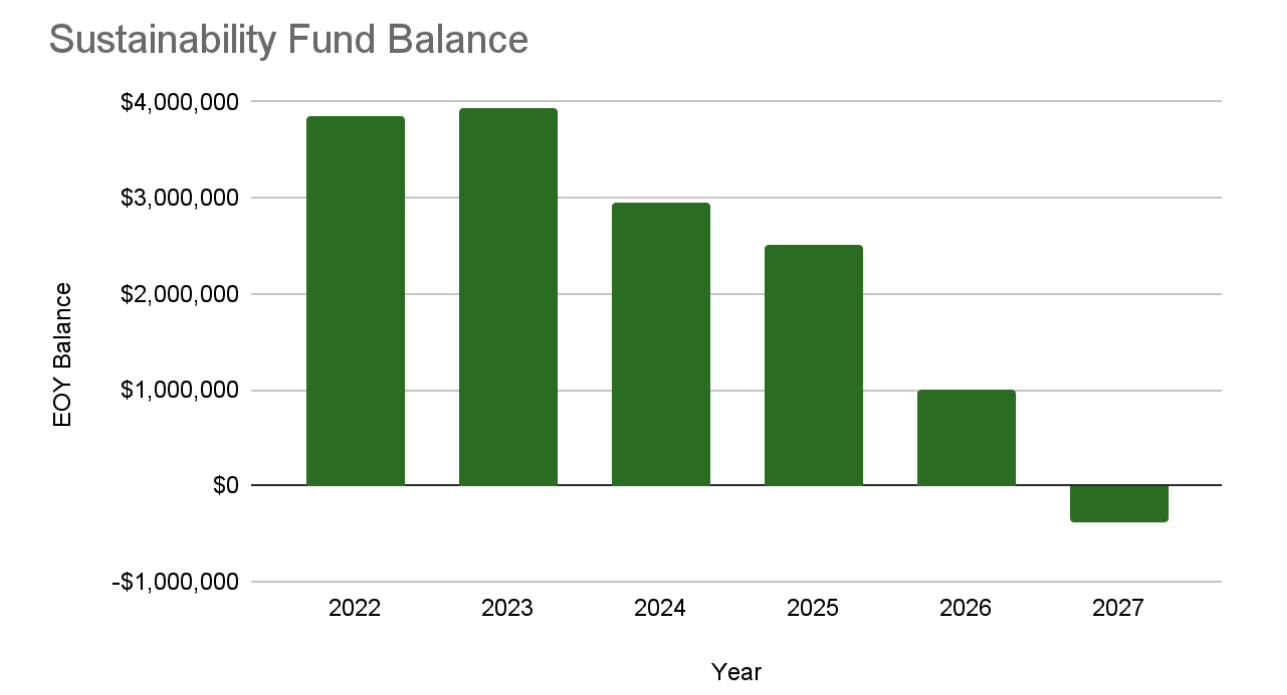
Sustainability Fund expenditures, revenue and balance 2022-2027
Current revenue sources
The current revenue sources for the Sustainability Fund are the Community Choice Aggregation Energy Efficiency Rebate, Plastic Bag Fee Revenue and a Transfer from the Environmental Services Fund. These income sources are variable and not enough to keep up with our current $1.7MM in annual Sustainability expenses, leaving a gap of about $1.4M in revenues to replace.
| Revenue Source | 2022 | 2023 | 2024 | 2025 | 2026 |
| Community Choice Aggregation Energy Efficiency Rebate | $217,848 | $65,090 | $56,000 | $60,000 | $100,000 |
| Transfer from Environmental Services Fund | $150,000 | $150,000 | $150,000 | $150,000 | $150,000 |
| Bag Fee Revenue | $163,818 | $162,930 | $150,000 | $160,000 | $160 ,000 |
| Total | $531,666 | $378,020 | $356,000 | $370,000 | $410,000 |
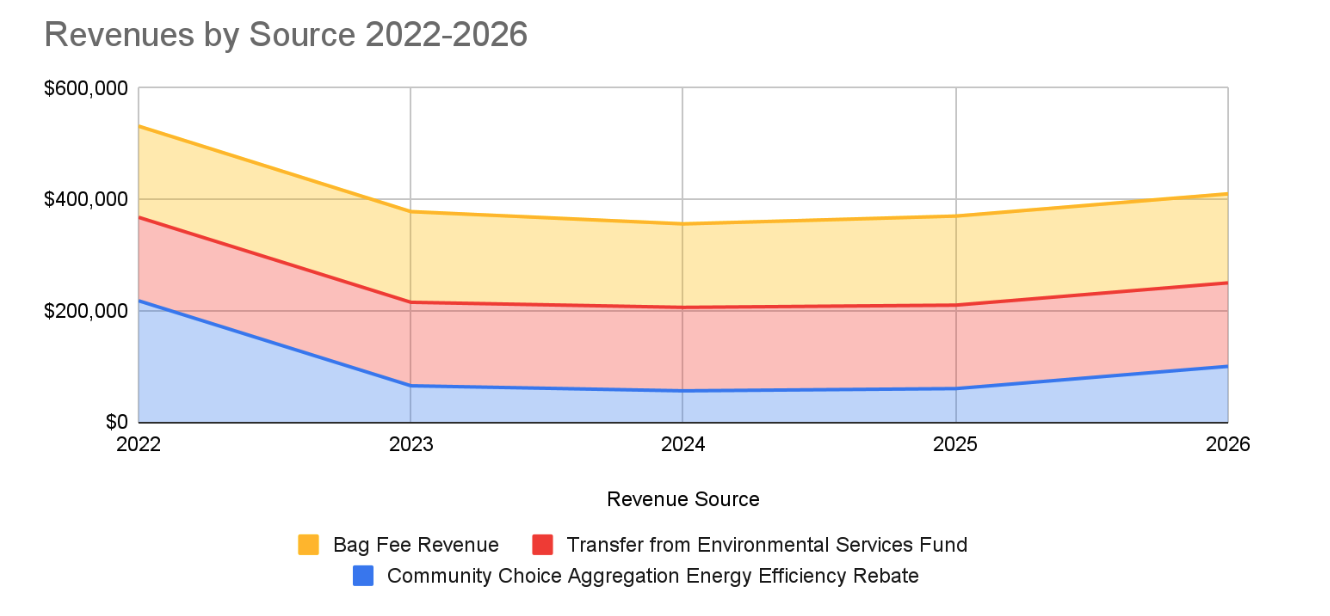
Sustainability Fund revenues 2022-2026
Stabilizing the Sustainability Fund
In order to fill this $1.4M Sustainability Fund gap and grow our sustainability programs and initiatives, stable funding sources must be identified. Below are seven initiatives to stabilize the Sustainability Fund for discussion with the Village Staff and Board. The initiatives are intentionally framed at a high level, leaving details and implementation in our Staff’s capable hands once there is consensus of the Village Board. The goals of these initiatives are to treat sustainability as a core service, stabilize revenue, and incentivize pro-climate behavior by reducing waste and activities that cause pollution.
A. Invest annually from the General Fund in Energy Efficiency Grant and Loan Programs
In 2025 and 2026, $750,000 has been allocated in our Sustainability budget for the Energy Efficiency Grant Program, and most recently the new Energy and Multi-Family Loan programs. To reach a significant portion of the 19,439 households that still must be electrified by 2050, the Village must sustain investment in these grants and loans. To achieve this, funding from the General Fund must be allocated every year, with a focus on growing the revolving loan fund.
$350k has been earmarked for $10k single and multifamily building loans in 2026. These loans have no interest and are paid back over 5 years, which allows the funds to be redeployed once they are paid back. $10k unfortunately is not enough to fully electrify most homes, limiting the impact and likelihood of hitting our emissions reduction goals.
The below table projects $350,000, $1,000,000 and $2,000,000 investments in the Energy Loan Program through 2050 for $10k, $25k and $50k loan amounts:
| $350k/year | $1MM/year | $2MM/year | |
| Number of 10k loans by 2050 | 4,190 | 11,400 | 22,492 |
| % OP homes impacted | 21.55% | 58.64% | 115.71% |
| Number of 25k loans by 2050 | 1,676 | 4,560 | 8,997 |
| % OP homes impacted | 8.62% | 23.46% | 46.28% |
| Number of 50k loans by 2050 | 838 | 2,280 | 4,498 |
| % OP homes impacted | 4.31% | 11.73% | 23.14% |
Note: This projection assumes 100% uptake of these loans every year and does not account for any interest earned on fund balances. Data behind these calculations can be found here
To fully commit to meeting our own emissions reduction goals, we must invest $1M to $2M in this loan program annually through 2050.
B. Move Office of Sustainability staff salaries to the General Fund
Current staff salaries for the Sustainability and Resilience Office (3.5 FTE) are drawn from the Sustainability Fund. Sustainability needs to be treated as a core service, and these staff deserve to have more job stability by knowing the funding for their positions is secure. We can accomplish this by moving these salaries over to the General Fund, and reducing annual Sustainability Fund expenditures significantly.
C. Increase the plastic bag tax
The City of Chicago recently raised their plastic bag tax from 10 cents to 15 cents in their 2026 budget. By following suit with our own plastic bag fee increase, Oak Park can raise additional revenue and continue to incentivize shoppers to use fewer plastic bags. The Environment and Energy Commission is researching a long term plan for plastic bag fees, which we would like to see presented to the Board.
D. Electric Charging Fees
Currently all fees collected with EV charging go into the Village Parking Fund, which for 2026 is estimated to be $40,000. This revenue should be earmarked for the Sustainability Fund and is expected to grow with higher EV adoption rates.
E. Increase vehicle registration fees for gas cars, reduce them for EVs
The Village currently charges $74 for Annual Vehicle Licenses, with a reduced fee for persons 65 years old and older. The Village could reduce or eliminate this fee for electric vehicles and increase it for gas cars. This increase could be phased in over several years and would serve as both a revenue source and an incentive for residents to buy or lease EVs.
Additionally, the Village could charge by vehicle weight, as has been done in Paris, which charges an additional $20 for heavier vehicles. This would help incentivize smaller vehicles that cause less pollution and wear on our roadways.
F. Increase gasoline tax
The Village collected $417,852 in 2024 for gasoline taxes. We have seen this revenue go down in the past 10 years with higher EV and hybrid adoption. To further incentivize EVs and raise Sustainability revenue, a percentage of that tax could be earmarked for sustainability programs.
G. Identify new revenues from the Water Fund
The Village is currently engaging NewGen Strategies and Solutions to evaluate our Water and Sewer rates. Based on these findings, additional funding for Sustainability could come from a new usage rate design, using an inclining charge per unit to charge highest users more.
Although most of the funds recovered through this additional charge would likely need to be used for lead service line replacement, a percentage of the funds could be earmarked for sustainability programs annually like the Sewer Backup Protection and Climate Ready Rainscapes Grants.
Next steps
I look forward to input and reflections from staff and the Village Board on the findings and recommendations from this memo. This is intended to be a first step in framing the larger conversation we are planning to have on the Sustainability Fund on March 18th. I welcome questions and other ideas to help Oak Park rise to the challenge of meeting our critical climate action goals.
Want to get my next post in your inbox? Sign up for email updates »