Derek Eder
Civic Tech Builder

I use data, build tools, and organize people in Chicago to democratize power. Read more »
 DataMade
Founder and Partner
 Village of Oak Park
Trustee
 Chi Hack Night
Co-Founder and President Emeritus
Wanna talk? Email me
Want to get my next post in your inbox? Sign up for email updates »
What can we do about the affordability crisis in Oak Park?
Published on Jul 20, 2026
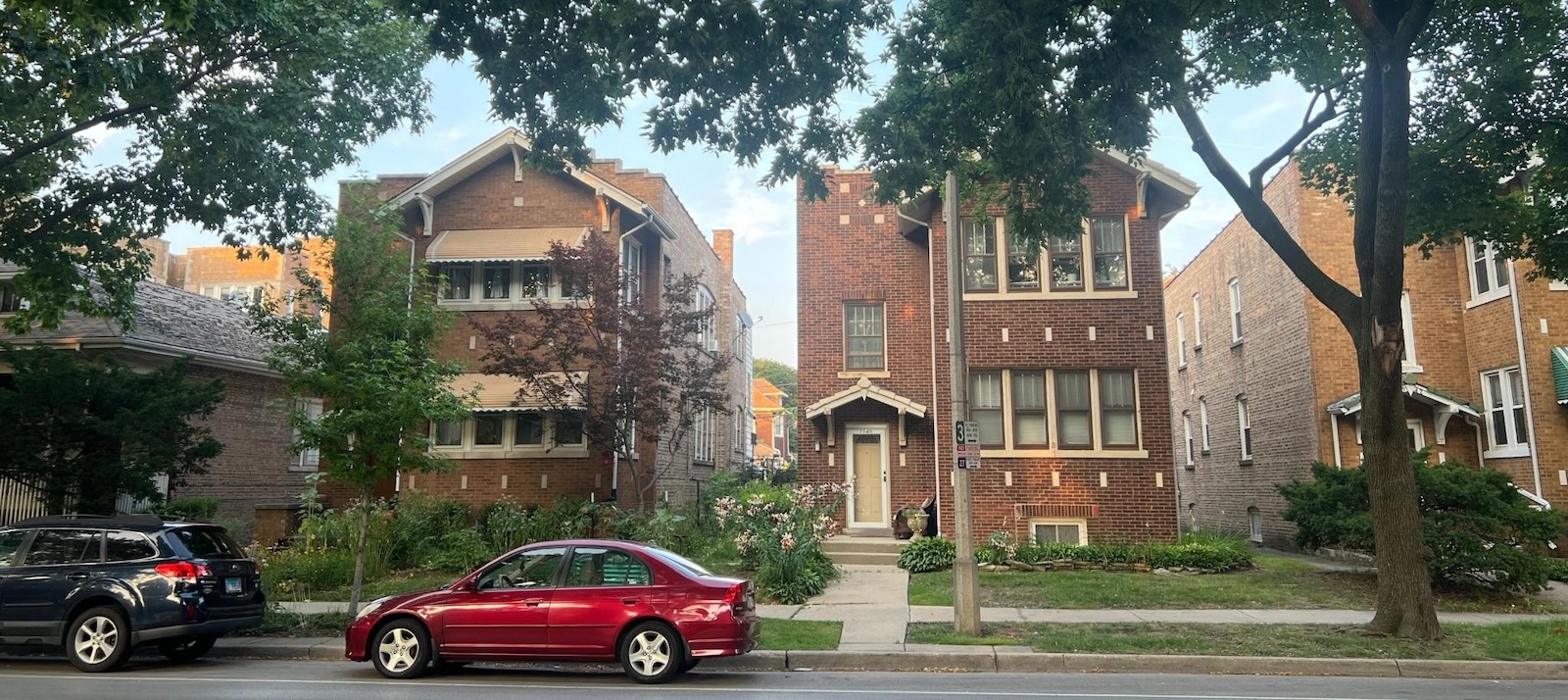
Middle density housing in Oak Park. Photo by Aya O’Connor
America is in the middle of an affordability crisis, and Oak Park is no exception. Prices for housing, child care, energy, and groceries are rising faster than wages, and families are feeling the squeeze. According to the Urban Institute, nearly half of people in American families cannot afford the true cost of living.
As we discuss what the Village of Oak Park can do to address affordability, it is important to look at the big picture and understand what is ultimately driving this national crisis: rising inequality and wealth concentration. The richest people in the world are getting richer every day, using that wealth to buy more assets and resources, and driving up prices for the rest of us.
More inequality means less affordability
In June of 2026, the world minted its first trillionaire, Elon Musk. While you might say ‘good for him, that has nothing to do with me,’ unfortunately, it does. It is a grim milestone and the latest example of a 50-year trend of increasing wealth concentration among a small group of extremely rich people.
How does Elon Musk getting richer impact you? It has to do with how much his wealth and the wealth of other billionaires is growing compared to ours, and compared to the economy as a whole. On average, the U.S. GDP grows about 3% per year. Since the COVID-19 pandemic in 2020, the wealth of the richest 0.1% has grown 40%. Where does all their new wealth come from? You guessed it: it comes from us.
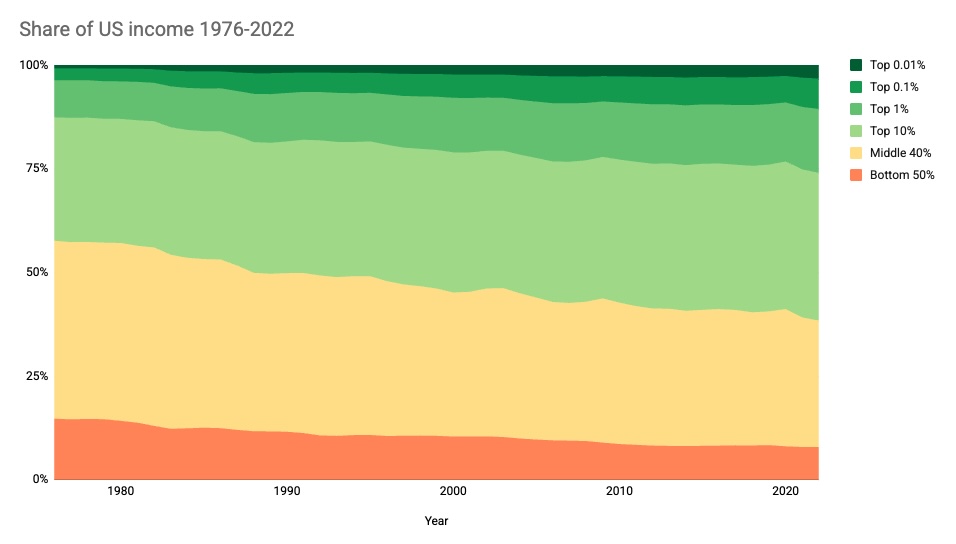
Share of U.S. income 1976–2022. Source: Realtime Inequality
Money works differently if you’re super rich. While most of us earn our money through the jobs we work, billionaires and trillionaires make their money through the companies and assets that they own, and they do it all without lifting a finger (this is otherwise known as passive income). When you have more money than you could ever spend in your lifetime, you wisely invest it in a diverse set of assets: stocks, natural resources, and yes, housing.
The most direct solution to this is taxing billionaires’ assets. However, as a Trustee for the Village of Oak Park, I do not have the power to do that. Instead, we must look to the policy tools we can control: local policy, incentives, and taxes.
The cost of doing nothing
I know that if I and the rest of the Village board don’t act, home prices will continue to rise, new families will not be able to afford to move here, and some of our schools may have to close. I have seen what that means for a community like ours, because I used to live in one.
I grew up in Lake Oswego, Oregon, an affluent suburb of Portland. My parents, both of them teachers, decided to move there because of the excellent schools.
I graduated from Lakeridge High in 2001. But just 10 years later, their school board closed 3 elementary schools, including the elementary school where I went and where my mom taught Special Ed.
Why did this happen? Because there were not enough students and new families moving there to keep up with enrollment; the median home price in Lake Oswego is $932,000, double the amount in the surrounding areas.
Fast forward to 2018, my family with two young children decided to move to Oak Park for the good schools and racial diversity. Needless to say, my family would not be able to afford a $932,000 home, and if prices were that high in Oak Park, we would not have moved here. And certainly, there would not be racial diversity.
If we want to avoid Lake Oswego’s future in Oak Park, to keep our schools open, and to continue seeing new, diverse families moving in, we have to address housing affordability.
Measuring the housing crisis in Oak Park
Thankfully, there is time to act in Oak Park, but it’s a steep hill to climb. Our median home price is $525,000, which is high for Illinois and above the national average. Oak Park is less affordable than all of our neighboring municipalities except for River Forest and Riverside.
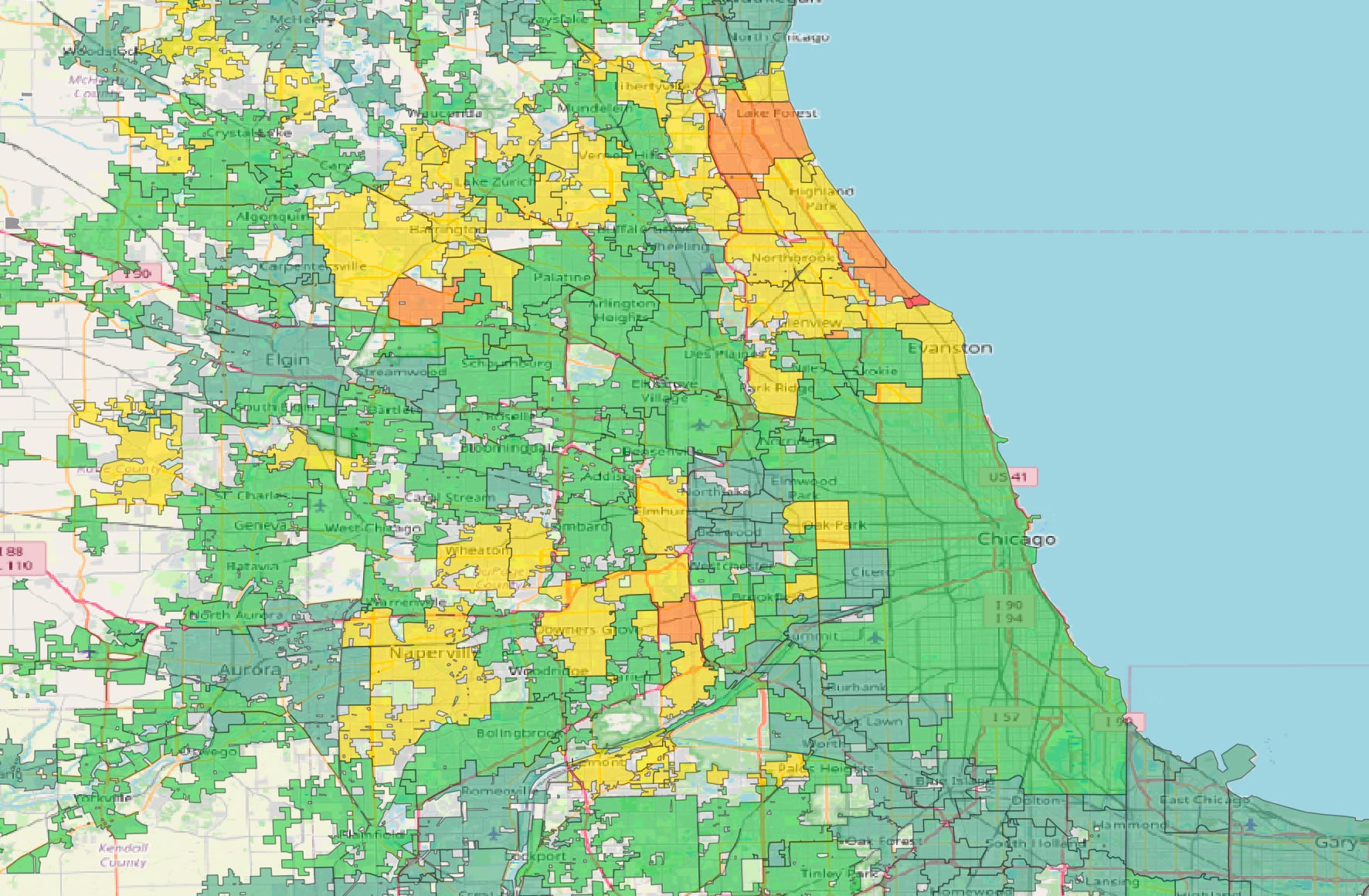
Affordability index for Chicago and surrounding suburbs based on home price vs median income. Green are considered affordable, yellow and orange are not. Source: M. Nolan Grey
As a Village, we have the power to incentivize building more market rate and affordable housing and lower prices by increasing supply. And while the most common housing type in Oak Park are single family homes, we know from the 2024 Strategic Vision for Housing report that there is a need for different kinds of housing to support households at various income levels and stages of life.
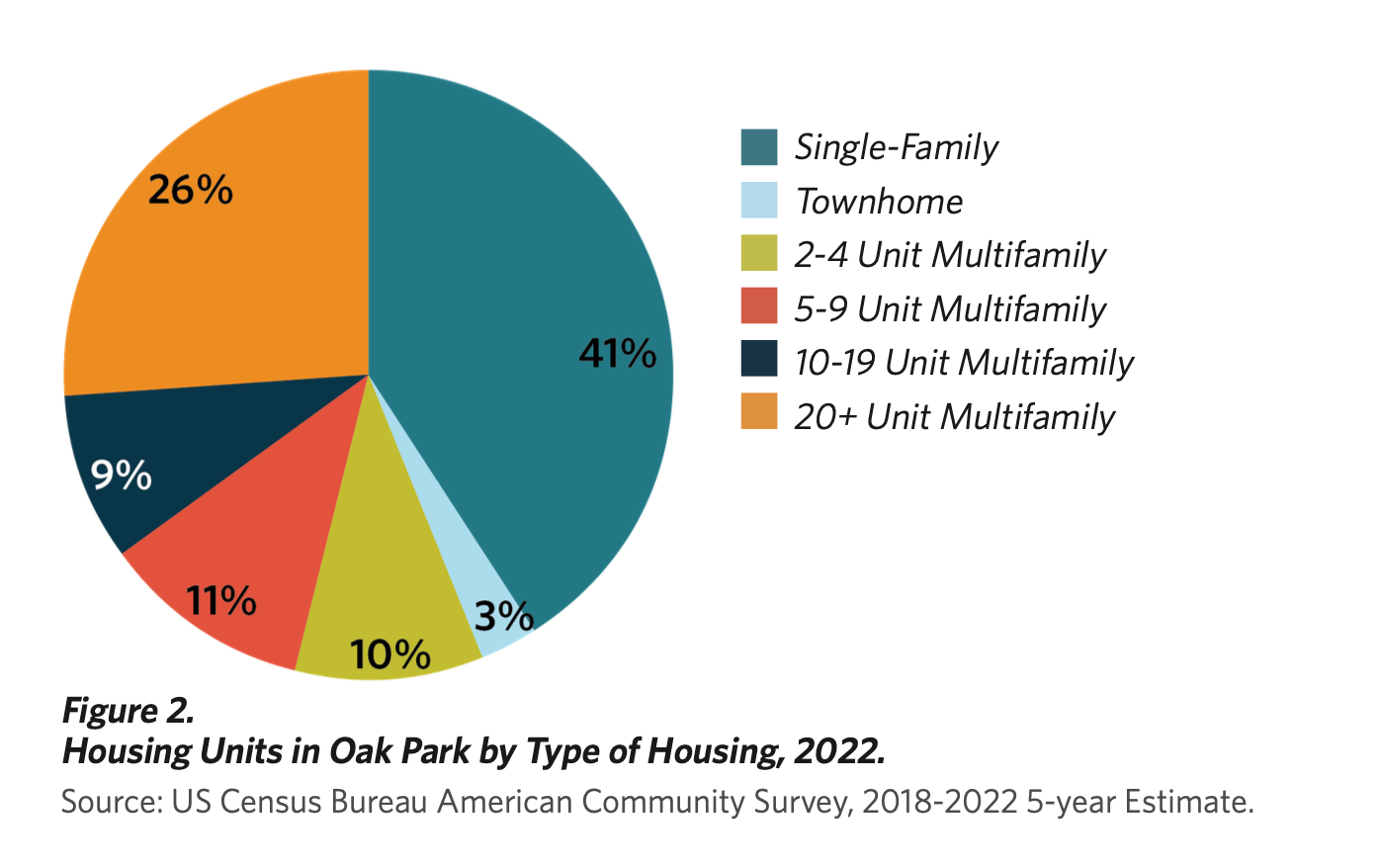
While 67% of Oak Park households are only 1 or 2-persons, 41% of our housing units are single family homes. Many of these homeowners are seniors (a population that has doubled to 17% in the past 20 years) who would like to age in place, but in a more manageable home. The problem is, there are very few housing options for them to downsize into.
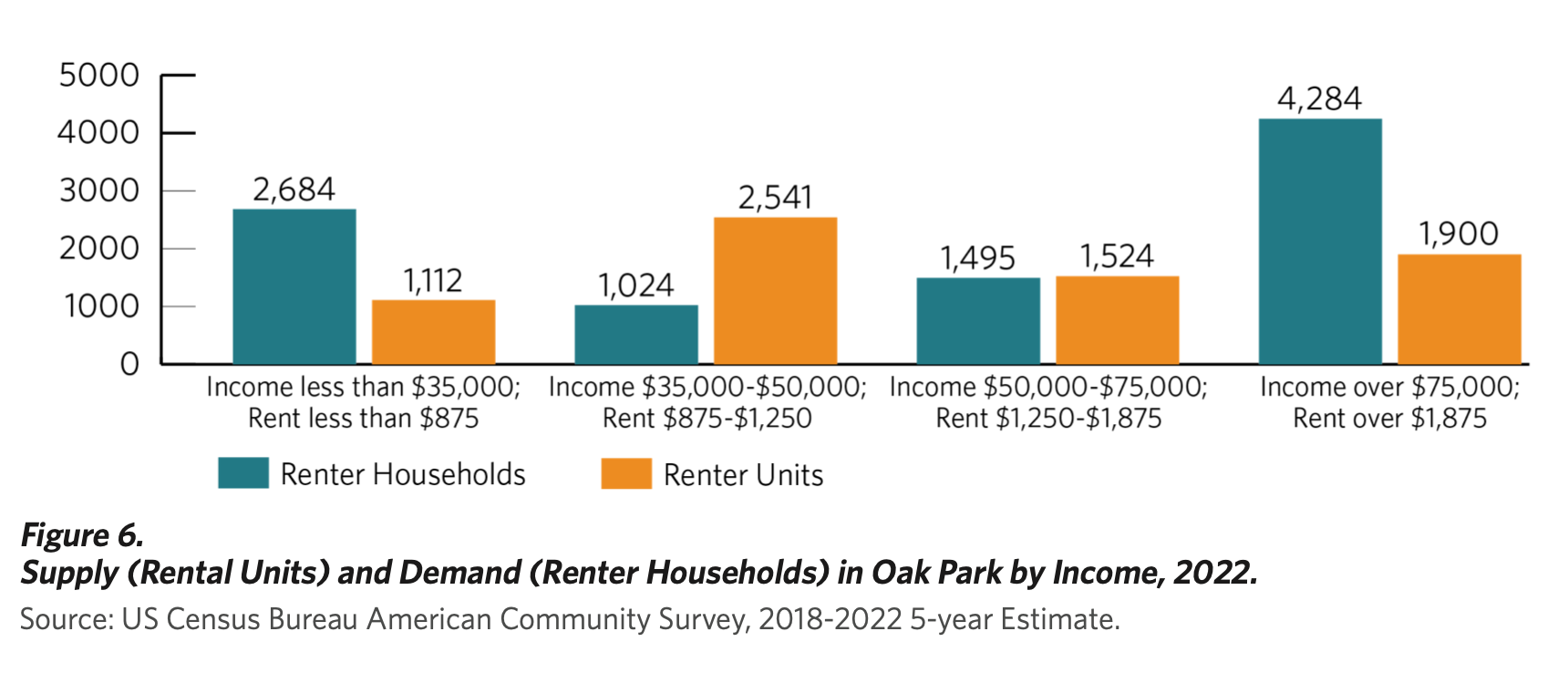
It is also worth noting that 40% of Oak Park’s population are renters. And those renters are facing increasing rents and a shortage of units. Based on supply and demand from the U.S. Census, Oak Park is 1,500 rental units short of meeting the current demand.
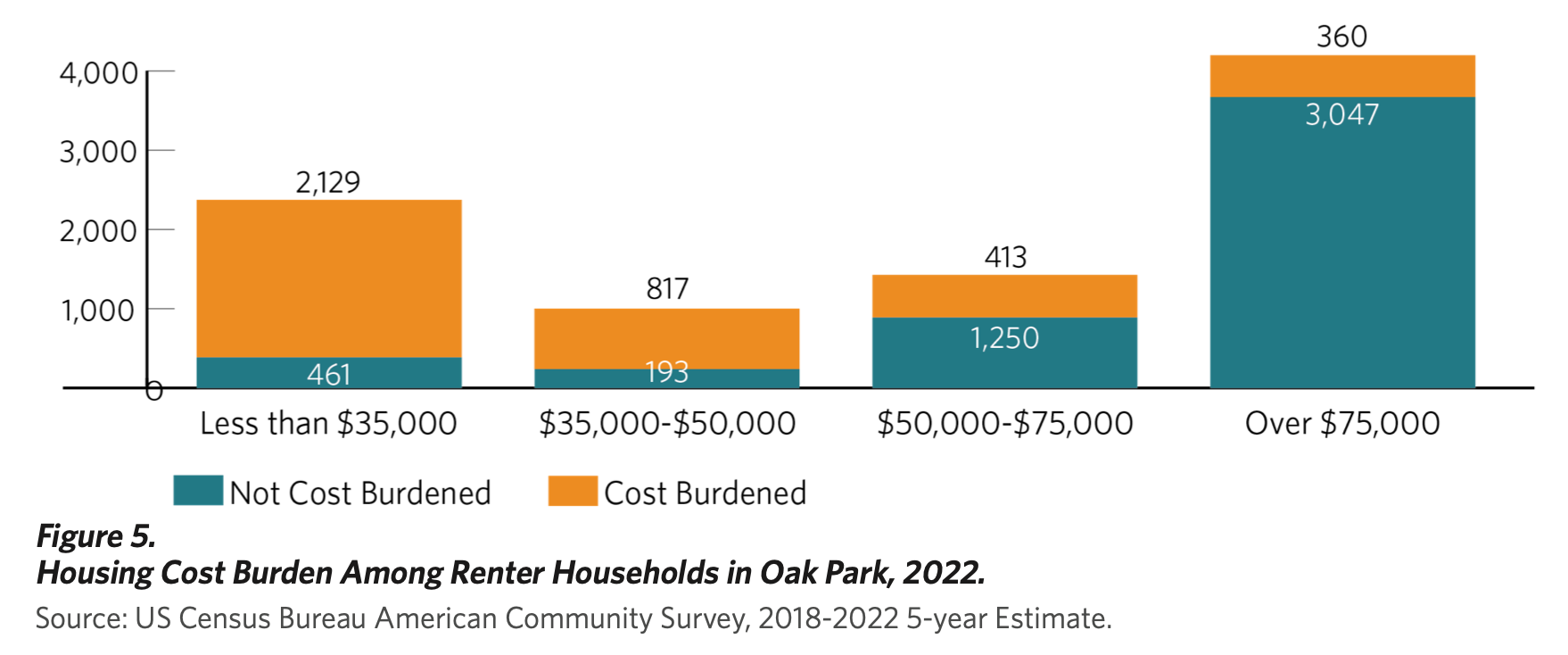
Of those renters, 44% of them are “rent burdened,” meaning they spend more than 30% of their income on housing. The rent burdened percentage jumps to over 80% for households making less than $50,000 a year.
The Strategic Vision for Housing identifies a number of other housing challenges in our Village, including a substantial racial homeownership gap, a lack of shelter for people experiencing homelessness, high emissions from heating our homes, lack of accessibility, and an aging housing stock.
One thing is clear: there is a need to act, and there are several policy levers we can pull to help address these challenges.
Policy lever 1: Changing the zoning code
To allow for this increase in supply and housing diversity, the biggest policy tool we have is changing our zoning code. In Oak Park, as it is in every city and town, the zoning code determines how big of a building you can build on a property and what you can do inside it. (As a fun aside, one of the most successful civic tech projects I’ve built is Second City Zoning, an interactive zoning map for the City of Chicago inspired by Sim City 2000. You could say I’m into zoning).
Some districts allow high rises to sprout around downtown, others encourage walkable, mixed-use commercial corridors, but the vast majority of land in Oak Park (86%) is restricted to one building type: the single family home.
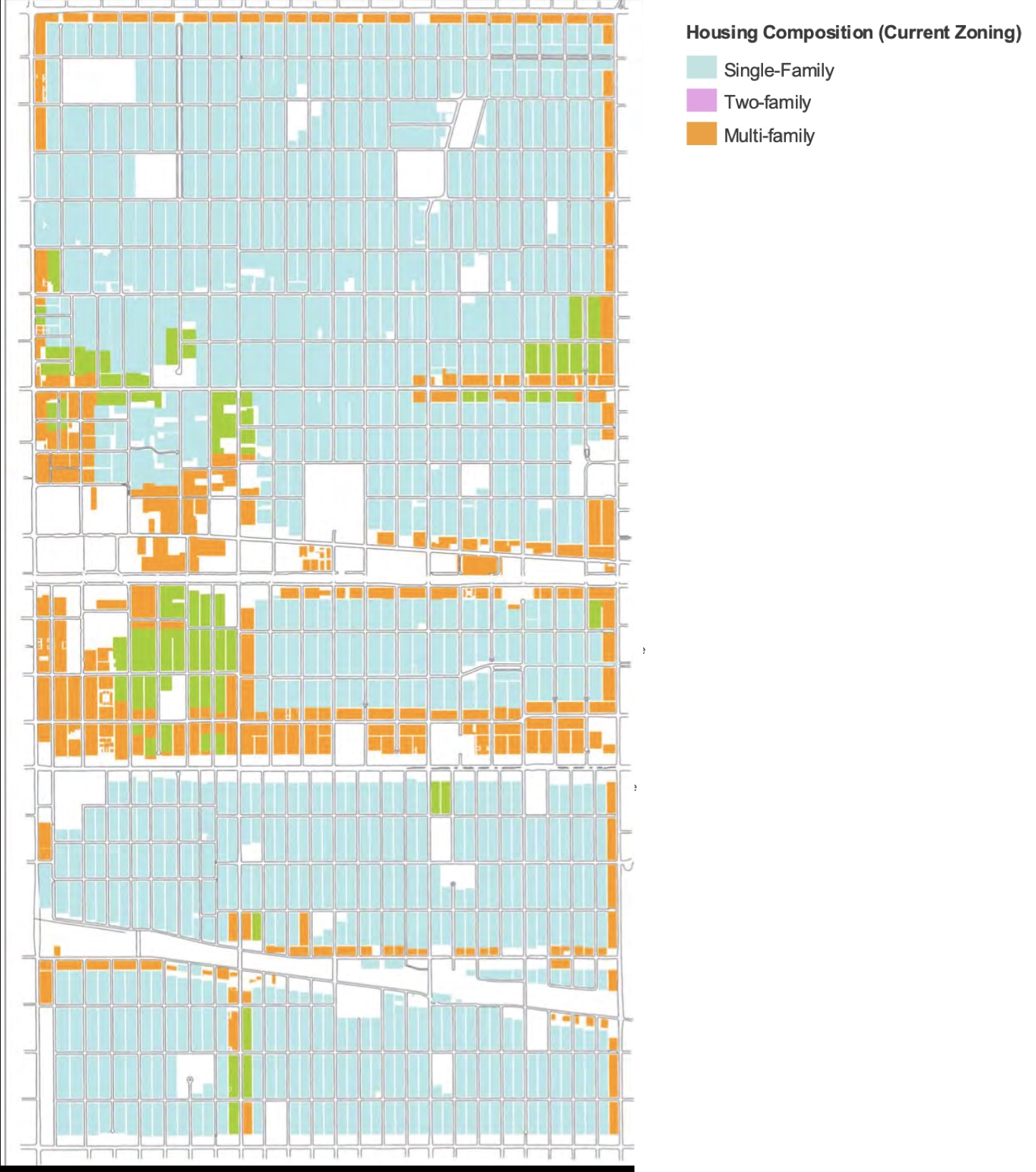
Housing composition of Oak Park’s current zoning. 86% of the land only allows for single family homes (light blue). Source: Opticos Design
Allowing for building duplexes, 3-4 units, and accessory dwelling units (also known as ADUs or coach houses), in addition to single family homes across the Village, would allow for more low density housing (also known as Missing Middle housing) to be built slowly over time, increasing supply and reducing costs.
There are many considerations to make regarding changes to zoning, including building height, setbacks, and other details that determine the shape and character of our streets and neighborhoods. I encourage you to read the extremely detailed report by Opticos Design presented in March that dives into the details of these considerations.
Policy lever 2: Inclusionary Housing Ordinance (IHO)
Changing the zoning code in this way alone, however, will not guarantee that any of the new units that are built are affordable. To do that, we must revisit our 2019 Inclusionary Housing Ordinance (IHO) that requires 25+ unit multifamily developments to either include affordable units or pay a $100,000 fee for each affordable unit not provided.
Despite the good intentions of this ordinance, Oak Park remains in the bottom 7% of Illinois municipalities for housing affordability, and as mentioned above, 44% of our renters are cost burdened.
We need to lower the threshold of units that are covered by this ordinance and increase the fees for not providing affordable units to better align with the cost of building.
How do we know this will work? Look to Minneapolis and Evanston
The scale of these changes may seem daunting, and we have already heard from residents who are concerned with how they’ll impact the character of our community and existing single family home owners.
We don’t need a crystal ball to know how these changes will impact Oak Park. We can look to cities that have already made these changes and see how they’ve fared.
In 2018, Minneapolis adopted their 2040 Plan, ending single-family zoning citywide, eliminating parking minimums (which IL has already done for most of Oak Park in the People Over Parking Act), expanding their inclusionary housing ordinance, and many other transportation, environment, equity, and economic policies.
The Minneapolis 2040 Plan
Six years later, their results are encouraging. Between 2020-2024, rents in Minneapolis fell by 4% compared to a 22% average national increase, and 87 new duplex, triplex, and fourplex buildings (otherwise known as missing middle housing) were permitted, creating 225 new housing units that would have otherwise not been built. The affordability crisis is not fully solved there, but meaningful progress has been made.
In Evanston, they updated their inclusionary housing ordinance in April 2025 and have already seen 84 new onsite affordable units built.
My position: changes to zoning and the IHO must be done together
As is often the case, there is no one policy change that will fix an issue as big as housing affordability. We need to change the zoning code to allow for more middle density housing, expand the inclusionary housing ordinance, and ensure that they work in tandem together to encourage the right mix of affordable and market-rate housing.
If we pass changes in Oak Park, what will happen? If we follow Minneapolis’ example, who will be impacted? Based on the research I’ve done and the experts I’ve talked to, this is what I predict:
- If you are a single family home owner, and your house is in good condition, nothing will change for you.
- If your single family home is in poor condition and is being sold, you may see a 2-4 unit building replacing it instead of a luxury $1.2M single family home.
- If you are a senior, you will see slightly more housing options to downsize into.
- If you are a renter, you will see slightly more rental options.
- If you are a low income renter, you will see slightly more affordable rental options.
Given the size and scale of the national affordability crisis and its root causes of wealth inequality, seeing real and meaningful progress like this within a few years of passing new local policies is a good goal to strive for. We have to try.
If you are interested in learning more and joining the effort to bring more affordable housing to Oak Park, check out AffordableOakPark.org.
Special thanks to Aya O’Connor and Jenna Leving-Jacobson for their contributions to this post.
Want to get my next post in your inbox? Sign up for email updates »
Email signup • derek@derekeder.com • © 2026 Derek Eder